- Cause
-
- Atony obs. distended bladder
- Retention of placenta, placenta accreta
- Obstetric Trauma (Hematoma, Rupture and Laceration)
- Coagulopathy
- Distended Bladder
- Atony obs. distended bladder
- Treatment:
-
- Massage of the uterus until hard and give oxyticin 10 IE/IM or directly in the uteris and slowly IV
- Placenta Out by controlled cord traction if unsuccesfull remove placenta manualy. Give appropiate IV/IM antibiotics.
- Inspection
- Coagulation status: Thrombocytes, APTT, PP, fibrinogen, D-dimer, ATIH if bleeding is in progress (aggressive)
- Two large bore IV line, Foley catheter, Oxygen by mask
- 3-4 liters crystalloids, replace 1 liter blood if shock with systolic blood pressure less than 90 mm Hg, pulse faster than 110 beats 1 Litre fluid in 15 minuts (as rapid as possible).
- Before use, correct for acidosis and acidenia.
- In case of continuously bleeding, use Novoseven, but thrombocytes (> 5 mia/l) and Fibrinogen (> 3 mg/l) has to be available. Therefore the acute package can be used. This consist of
- 5 SAG-M + 5 FFP (or Fibrinogen 2 g (30 ml/kg) or co-precipitate as indicated) and
- 2 package of thrombocytes concentrate 5 ml/kg and give 50 mg/kg Novoseven over 2-3 minutes.
- If thrombocytes is not available, use 100 mg/kg.
- Oxytocin 10 IU slowly intravenous (cave hypotension) or intramyometrial
- Oxytocin infusion 20 units in 500 cc 30-60 drops/minute.
- Methergin 0.2 mg (cave hypertension and coronary insufficiency), repeat after 15 minutes. Maximum dose 1 mg.
- 15-Methyl PGF2a Hemabate (0.25 mg IM/intramyometrial) repeated after 15 minutes not more than 2 mg (cave asthma,hypertension, severe heart disease, liver disease and glaucoma)
- Misoprostol 2-5 tablets rectally
- Tachyphylaxis can develop and different receptors involved so use more than one type if no effect
- Laparotomy
-
- B-Lynch suture.
- Multiple square suturing from an arbitrary point in the heavily bleeding area is selected and the entire uterine wall from the serosa of the anterior wall to the serosa of the posterior wall is included, 2-3 cm between insertions.
- Stepwise ligation of uterine artery including the parametrium and 2-3 cm of the lateral wall of the uterus below and over the transversical incision and finally uteroovarian vessels
- Ligation of hypogastric artery (secure pulse in femoral artery)
- Subtotal or total hysterectomy, the transition zone between cervix and uterus can be felt like a bulk.
- Intraabdominal-pelvic packing with 10-12 laparotomy pads for 24-48 hours
- Placenta accreta/percreta
-
- Leave the placenta or cotyledons
- Suturing the placenta side
- Oxytocin hemabate and/or vasopressin in the placenta bed
- Balloon catheter with 400-500 cc
- I have used Tachosil supplemented with uterin packing with good results.

|
Dette dokument er flaget "Muligt forældet"
Find siden via vejledninger
Bleeding post partum
Main and Danish guidelines by the web master
|
Definition: More than one liter. In previous cesarean section: Ultrasound show the hypoechoic boundary is lost and the placenta appears contagious with the bladder wall. Color flow Doppler and MR may be used as adjunctive diagnostic tools. Fresh frozen plasma if more than 6 units of red cells given Give thrombocytes if platelets is less than 50,000 or bleeding more than 5 l. Cryoprecipitate as indicated Cyklocapron 1 g i.v. Novoseven (factor VII a) for uncontrolled bleeding: (see the table) CAVE: Plasma expanders can decrease the effect of Novoseven. Risk: Thrombocytes is contra-indicated if DIC caused by sepsis because of hypercoagulopati. Inverted uterus: Reposition should be performed immediately as a contruction ring around the uteris if more rigid and more engored with blood. IV fluid and pethedin 1 mg/kg IV or IM (max 100 mg). Do not give oxytocin until inversion is corrected. Manual reposition if possible in anaesthesia. Hydrostatic repositioning: Exclused uterine rupture, unfuse warm saline by rubber tube held 1-2 metre about patiens (an assistant blocks the vaginal office) give tocylitica nitroglycerin subhycial/absilan IV. Surgical reposition (laperotomy): Alice forceps in the dumple of the inverted uterus and upword traction (Huntington procedure) or cut the ring posterior using longitudinal incision (Haultains procedure). Suggestion for blood replacement and preparation for the use of Novoseven (Sandbjerg 2005)
Incision preferable in vagina and evacuation followed by suture only if the bleeding is easily detected following by packing of the cavity and the vagina (for compression). Removed after 8-24 hours. Supralevatorial Haematoma Incision and packing only close the vagina partially. Vaginal and sometimes uterine packing (stretch the uterine artery). Subperitoneal Haematoma Observation: If not progressing wait hours for not to get bleeding when the haematoma is incised Expl. Lap. or ultrasound guided). It can be necessary to do ligation of the anterior part of the internal iliacal artery (secure pulse in the femoral artery) can also be done by arterial embolisation. (a) B-Lynch (b) modified B-Lynch; (c) modified square 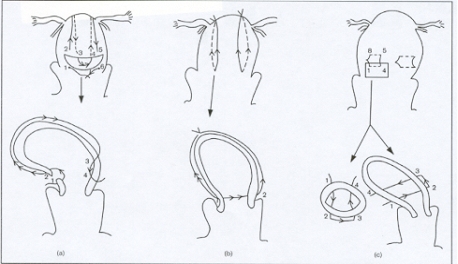
 A FLAPPY NON-BLEEDING UTERUS SHOULD NOT BE REMOVED AFTER UTERINE SUTURES IF BLEEDING HAS STOPPED
Interrupted circular suture for the anterior lower segment bladder  Stepwise Uterine Devascularization
3 Steps: Uni or bilateral ligature of uterine artery Uni or bilaterial ligature of descending branch of uterine artery Uni or bilateral ligature of the anastomosis from ovarian artery 
References: (1) AbdRabbo SA. Stepwise uterine devascularization: A novel technique for management of uncontrollable postpartum hemorrhage with preservation of the uterus. Am J Obstet Gynecol, 1994;171(3):694-700. (2) B-Lynch C, Coker A. Lawal A, Abu J, Cowen M. The B-Lynch surgical technique for the control of massive postpartum haemorrhage: an alternative to hysterectomy? Five cases reported. Br J Obst & Gynecol 1997;104:372-375. (3) Bonnar J. Massive obstetric haemorrhage. Balliere's clinical Obstetrics and Gynaecology, 2000:14(1):1-18. (4) Ghourab S, Al-Nuaim L, Al-Jabari A, Al-Meshari M, Mustafa S, Abotalib Z, Al-Salman M. Abdomino-pelvic packing to control severe haemorrhage following caesarean hysterectomy. J of Obst & Gyne, 1999;19(2):155-158. (5) Joo Yun Cho, Seok Joong Kim, Kwang Yul Cha,Chung Woong Kay, Myung Ik Kim, Kyung Sub Cha. Interrupted Circular Suture: Bleeding Control During Cesarean Delivery in Placenta Previa Accreta. Obstetrics and Gynecology, 1991; 78(5) Part I:871-879. (6) Maier RC. Control of postpartum hemorrhage with uterine packing. Am J Obstet Gynecol. 1993 Aug;169(2 Pt 1):317-21; discussion 321-3. (7) Mason BA. Postpartum hemorrhage and arterial embolization. Cur Opin Obstet Gynecol, 1998;10:475-479. (8) Life Saving Shills Manual. Royal College of Obstetricians and Gynecologists 2007 (9) Tamizian O and Arulkumaran S. The surgical management of postpartum haemorrhage. Curr Opin Obstet Gynecol. 2001 Apr;13(2):127-31.
Feel free to mail me |


Dette dokument er flaget "Muligt forældet"
Find siden via vejledninger
